Ying Wen
Home Publications Projects Teaching Blog AI Art 🌐 中文
🌐 中文
Home Publications Projects Teaching Blog AI Art

AI × Abstract Art

AI Art

What does a set of AI research reflections look like when translated into abstract visual language — problem, world, agency, experience, verification, abstraction, and cumulative science?

These works pair each original slogan with a visual reading. They are not paper illustrations, but another kind of research note: language preserves judgment, while color, boundary, path, and negative space carry intuition.

New series · 2026

Research Thinking: First-Principles Slogans

A 20-piece minimal abstract series on AI research taste: starting from real problems, grounding intelligence in the world, learning from experience, verifying claims, and building cumulative science.

Problem Before Method

Research Thinking · Minimal Abstract

Original slogan

Start from the problem, not the method.

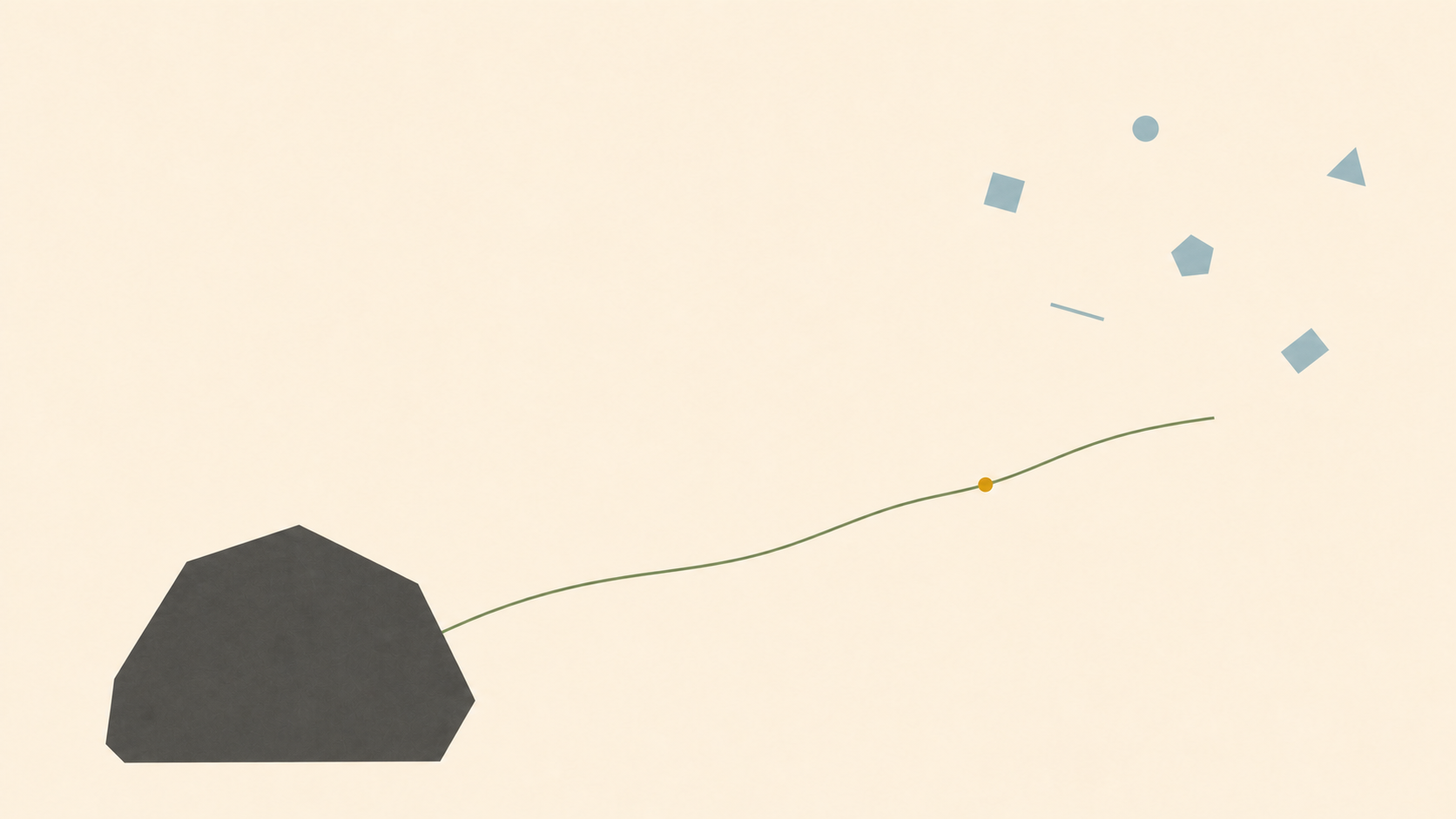
Reading The dark gray mass is the real bottleneck: the part of the world that resists easy progress. Blue method fragments hover above it, useful but not yet grounded; the green line begins at the problem itself and only then reaches an amber verifier. The reading is that good research does not start by asking which fashionable method to use, but by locating the constraint that would matter if solved.
World Before Model

Research Thinking · Minimal Abstract

Original slogan

Start from the world, not the model.

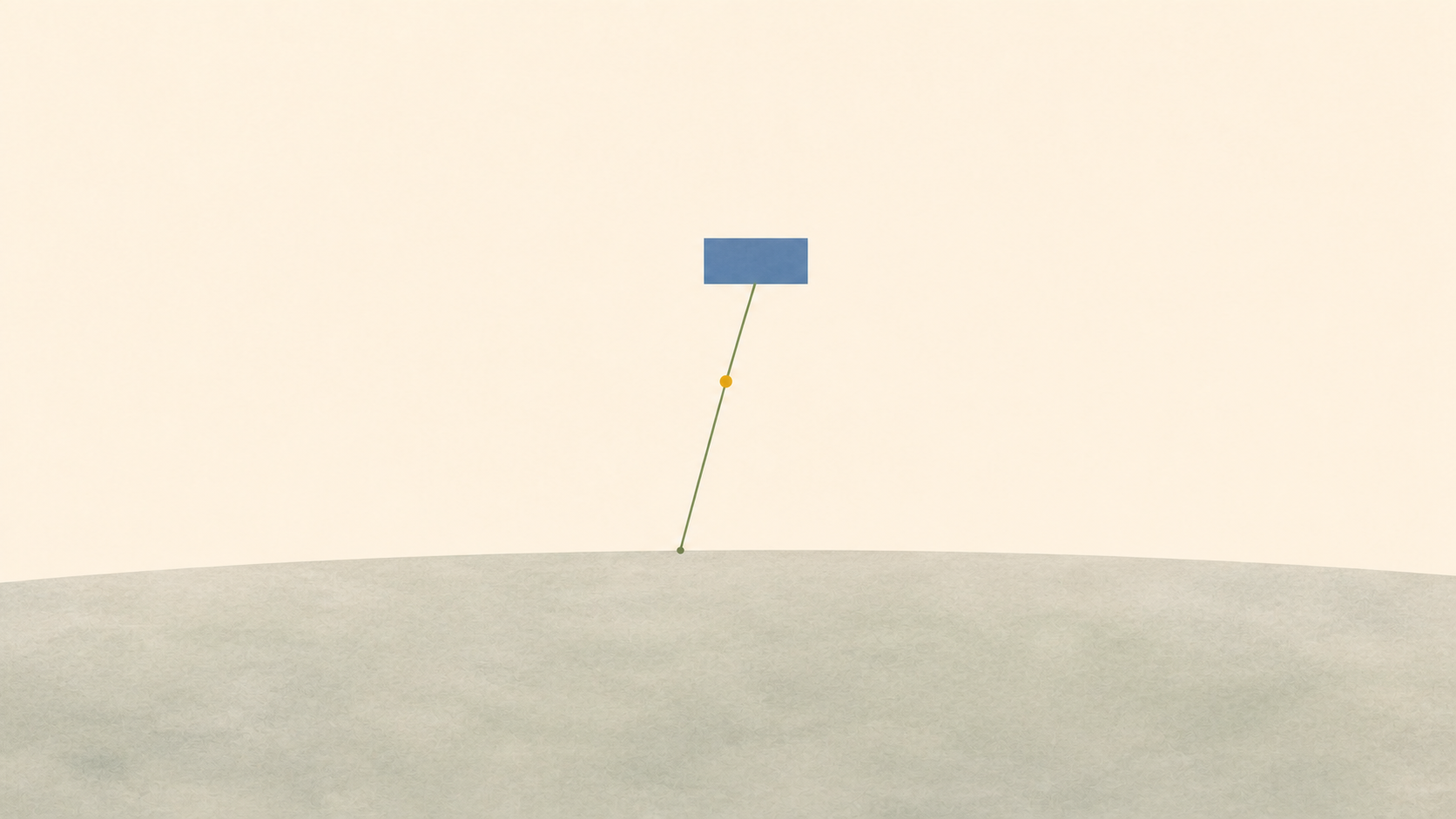
Reading The wide gray-green plane is the world: environment, signal, action surface, and consequence. The small blue form is a model, but it is intentionally small because it mediates a loop rather than replacing the world. The image pushes against model-centric thinking and asks whether the system has a meaningful relation to feedback, intervention, and external structure.

Agent-Centered Cone

Research Thinking · Minimal Abstract

Original slogan

Take the agent's point of view.

Reading The black aperture is the situated agent, and the blue cone is the portion of the world that becomes actionable from its position. It is not the observer's complete map; it is perception under limited information, cost, and delayed feedback. The red point outside the cone marks facts that may be true but cannot yet guide action, which is why agent-centered research must ask what the system can know, do, update, and recover from.

Experience Loop

Research Thinking · Minimal Abstract

Original slogan

Experience is closer than static data to the source of intelligence.

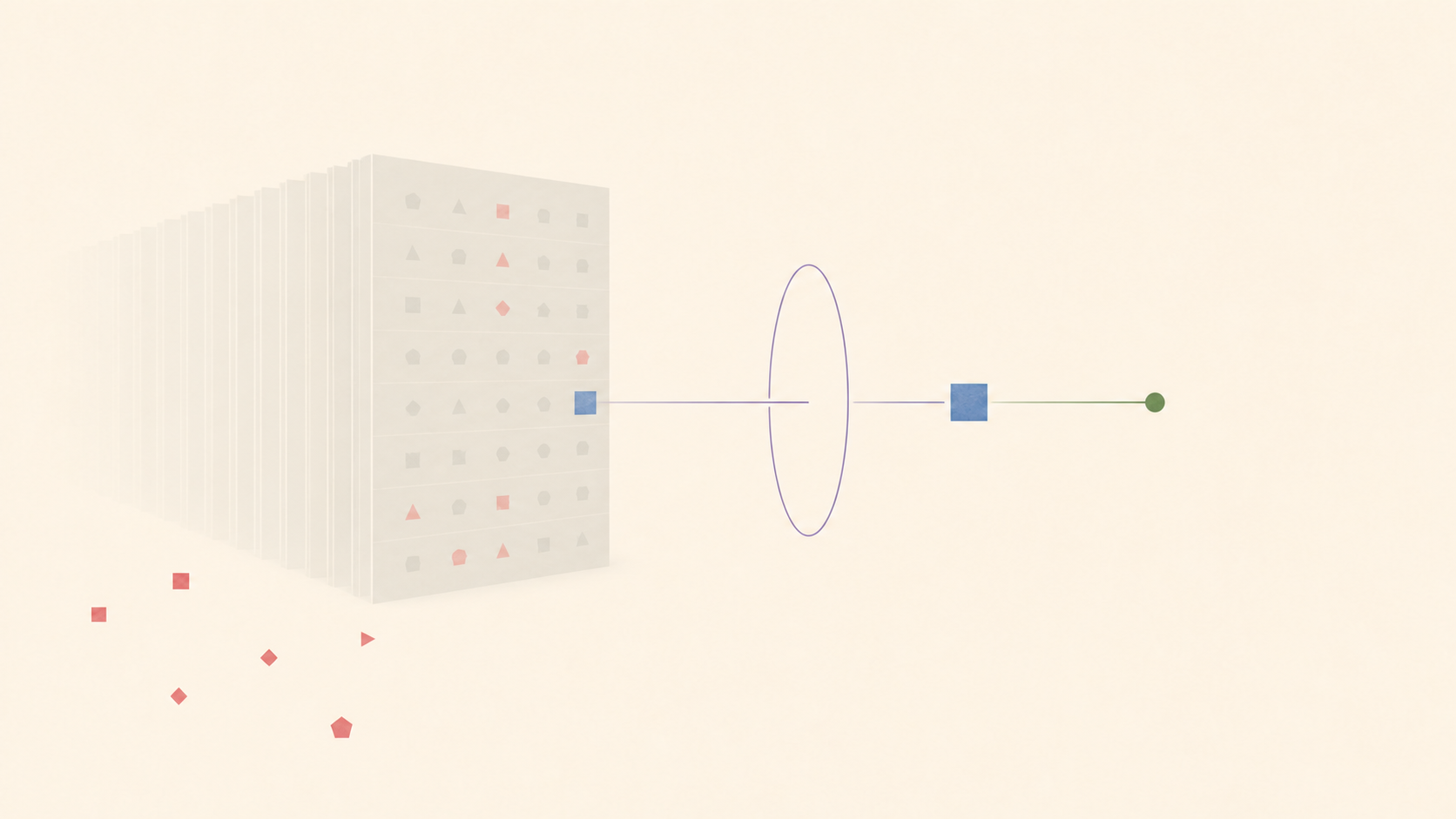
Reading The pale stack is static data: valuable, broad, and historically accumulated, but inert by itself. The small loop of observation, action, feedback, and trace is made visually primary because it can create new information and alter the learner. The point is not anti-data; it is that intelligence begins to compound when data becomes experience and experience becomes update.

Verification Gate

Research Thinking · Minimal Abstract

Original slogan

Do not let a system learn what it cannot verify.

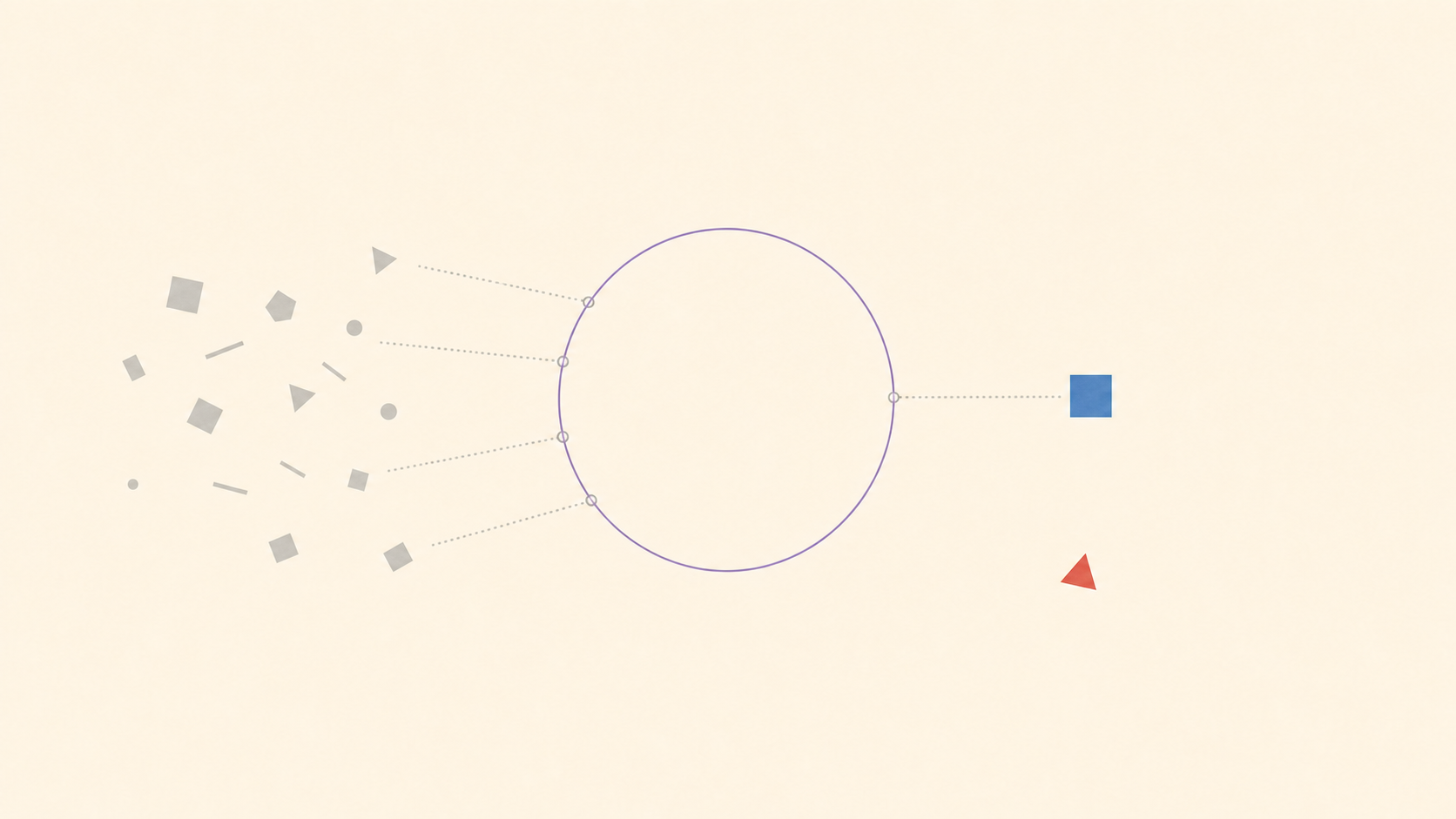
Reading Gray fragments approach a violet verification gate; only one becomes a stable blue object after passing through. The red fragment remains outside as residue rather than being absorbed into memory. The reading is a discipline of learning hygiene: feedback can be weak, delayed, social, experimental, or formal, but its strength must be named before the system treats it as knowledge.

Capability, Not Score

Research Thinking · Minimal Abstract

Original slogan

Measure capability; do not worship scores.

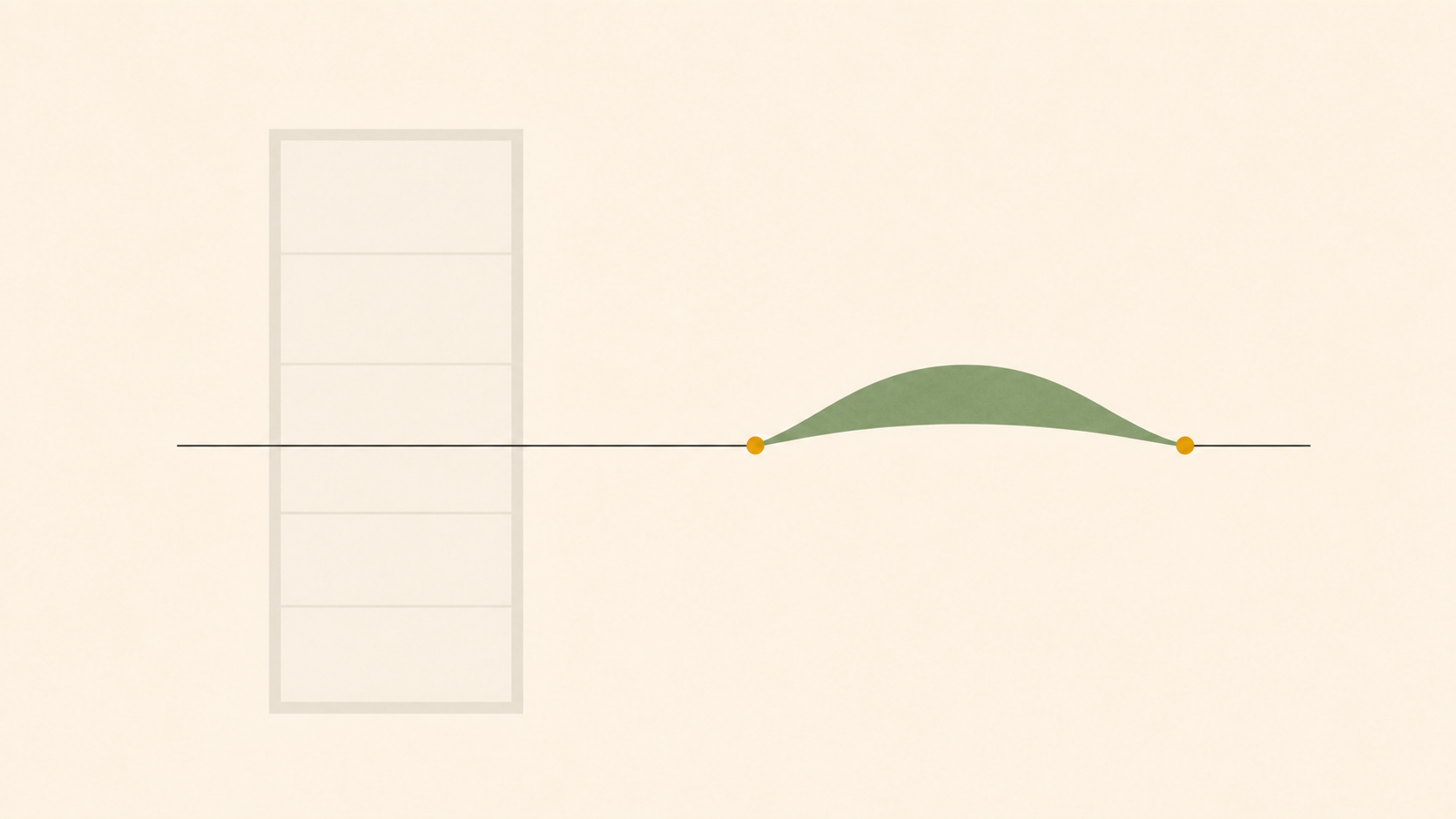
Reading The pale scoreboard is deliberately quiet: it records a number but does not prove capability. The green curve is anchored by amber measurements across contexts, suggesting transfer, persistence, recovery, and cost reduction. The interpretation is that benchmarks are instruments; they become misleading when the score replaces the ability concept it was supposed to measure.

Abstraction From Samples

Research Thinking · Minimal Abstract

Original slogan

Study abstraction, not only samples.

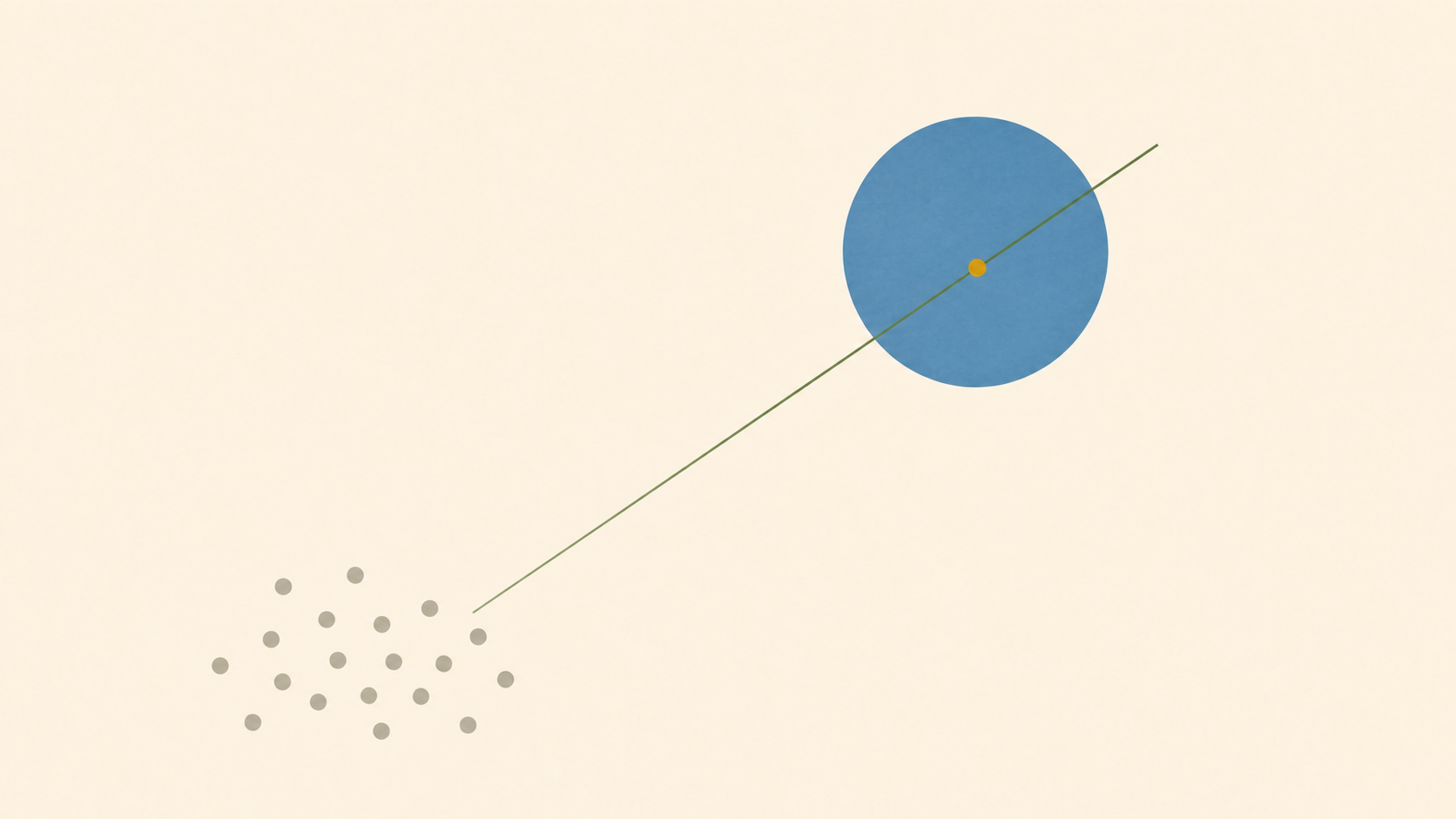
Reading A cloud of gray samples stays at the bottom while a blue structure rises out of it. The green action line and amber point make the abstraction testable rather than merely decorative. The reading is that intelligence is not the number of remembered cases, but the reusable structure extracted from experience and checked in new situations.

Useful World Structure

Research Thinking · Minimal Abstract

Original slogan

A world model does not replicate the world; it preserves useful structure.

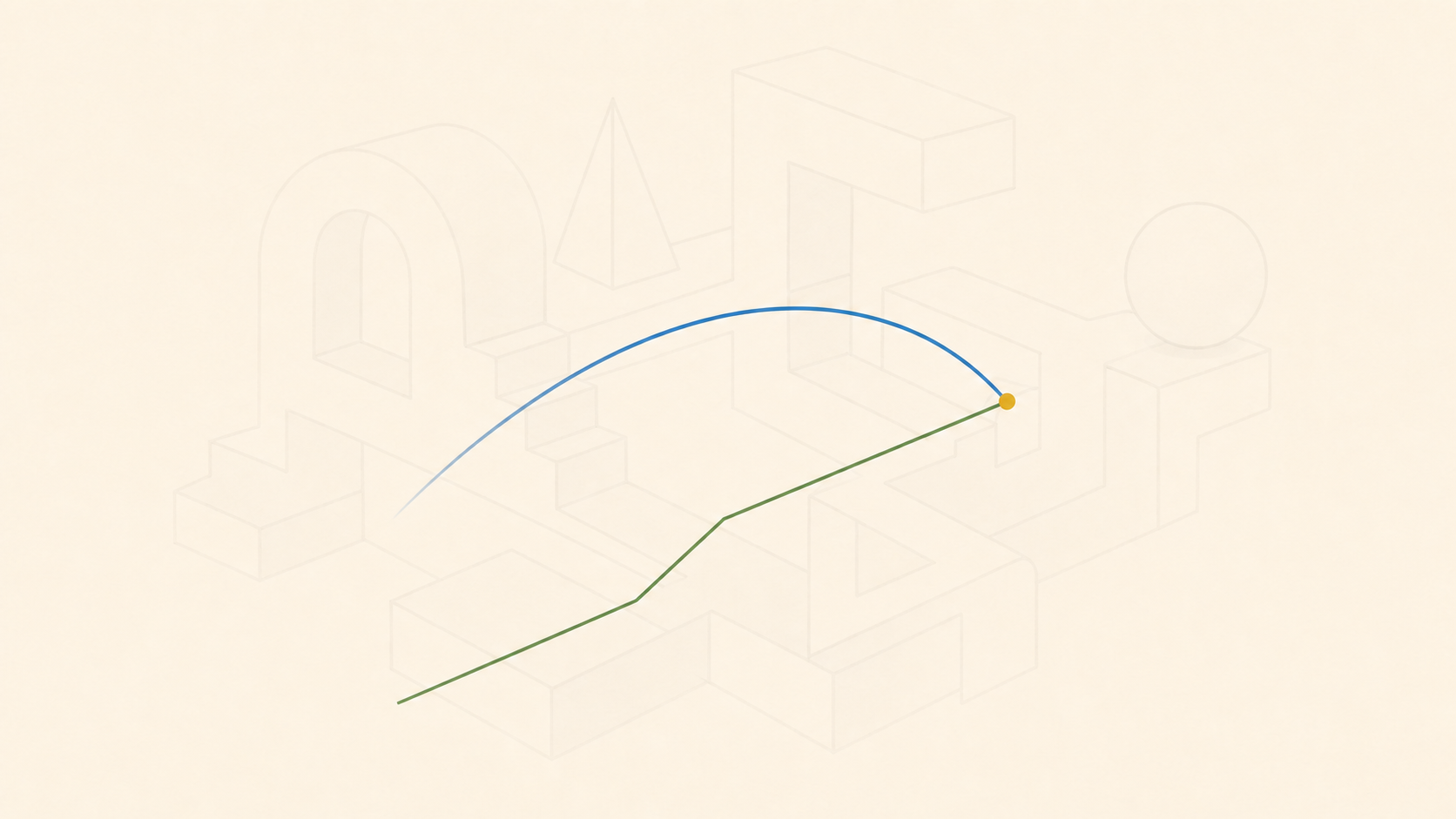
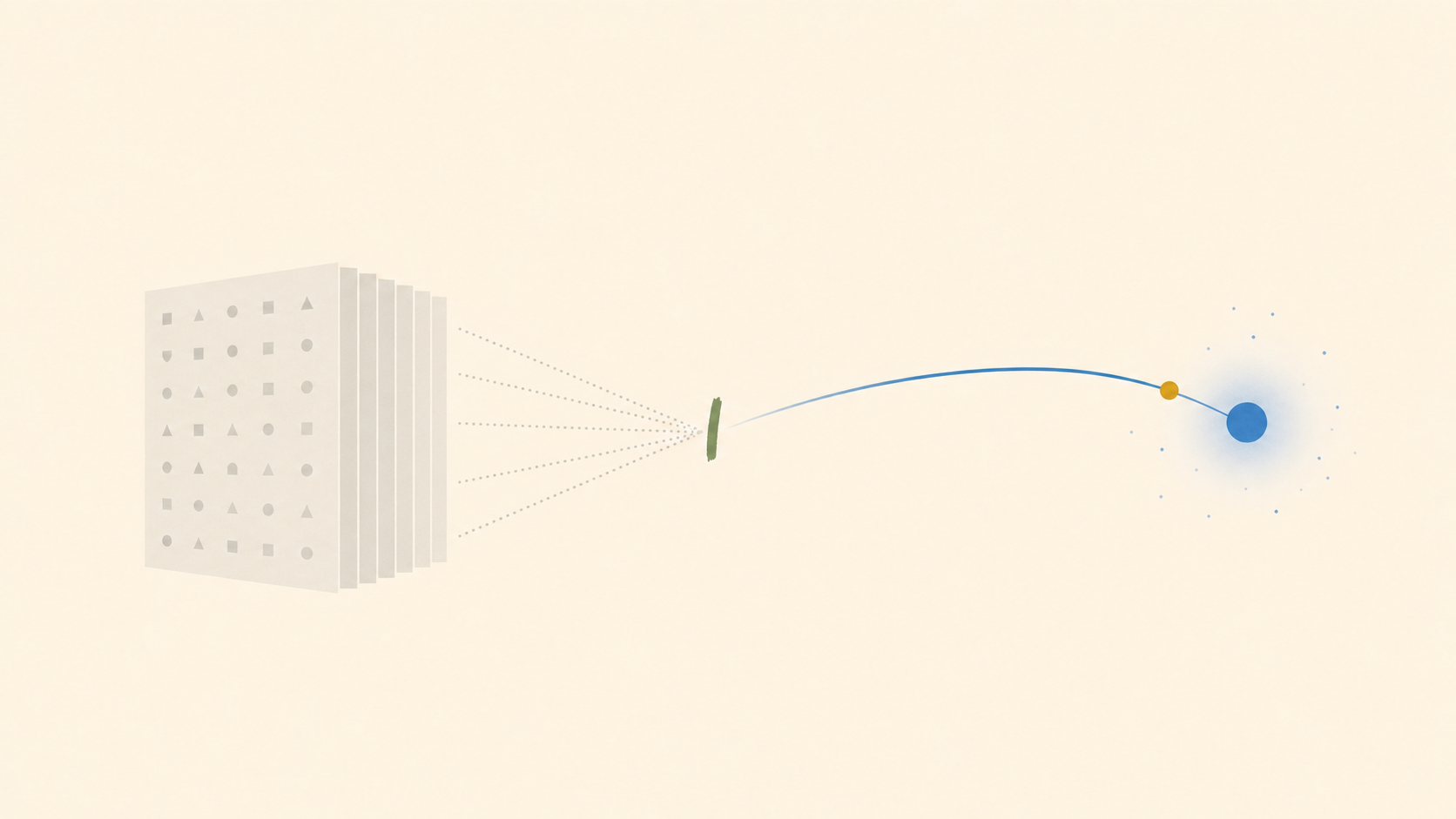
Reading A faint background suggests the impossible fantasy of a full world replica. In the foreground, only the useful structure remains: a prediction arc, an action path, and a validation point. The interpretation is that a world model is valuable when it helps an agent plan, act, discover variables, and correct mistakes, not merely when it looks realistic.

Scalable Mechanism

Research Thinking · Minimal Abstract

Original slogan

Long-term routes should scale general mechanisms, not manual tricks.

Reading The upper form repeats and expands like a mechanism that can compound with more compute, data, environment, or experience. Below it, red trick fragments remain isolated: clever, perhaps useful once, but not a route. The reading separates scalable mechanisms such as search, learning, planning, memory, and verification from brittle manual patches that only survive inside one benchmark or product shape.

Failure Rewrites the Route

Research Thinking · Minimal Abstract

Original slogan

Good research can change its own failure conditions.

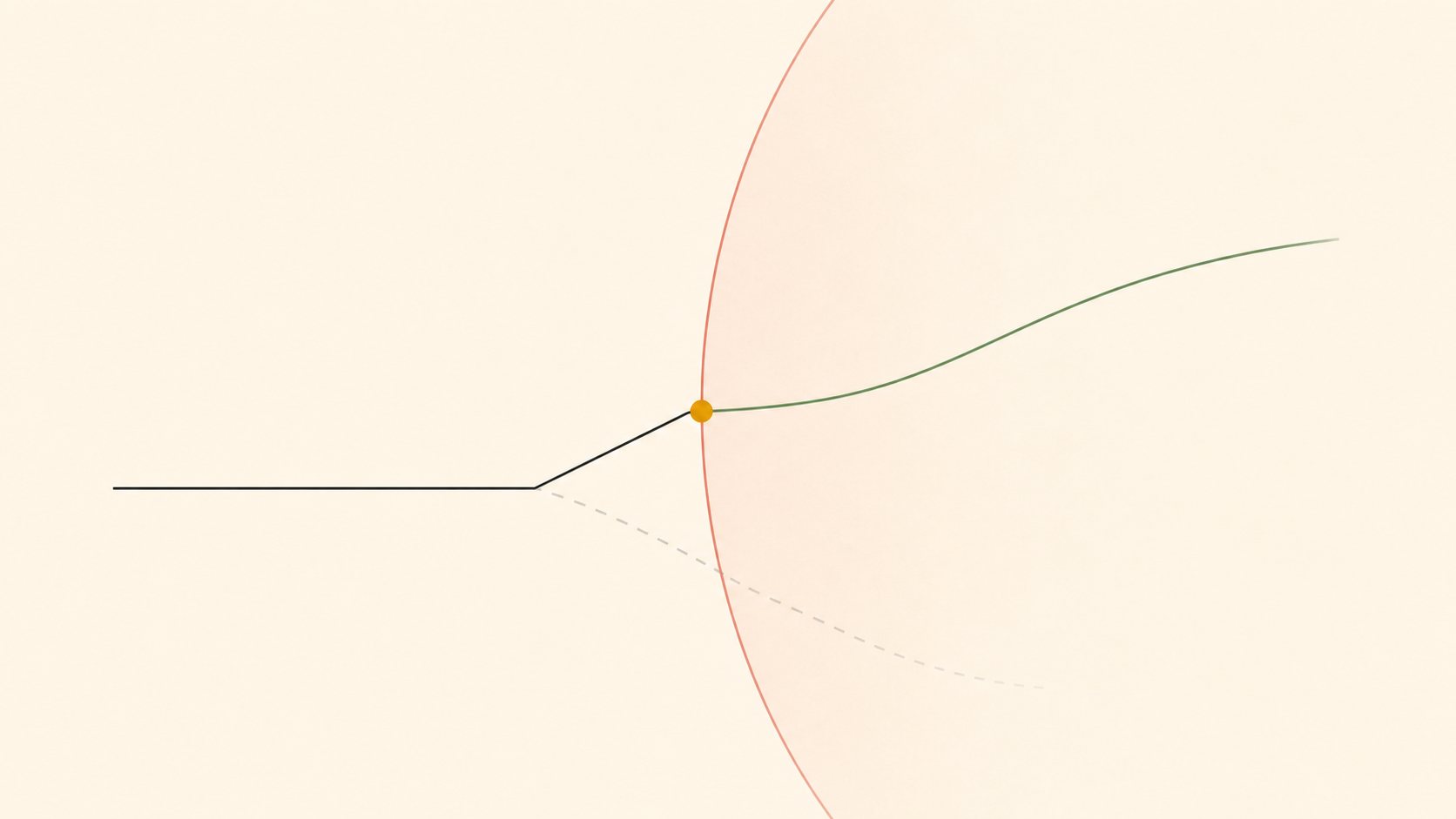
Reading A black hypothesis line hits a red failure boundary and then bends into a green route after the amber test point. The failure is not treated as an afterthought; it changes the path. The interpretation is that a research direction becomes scientific only when evidence can weaken it, redirect it, or force a clearer problem definition.

Small Experiment, Large Hypothesis

Research Thinking · Minimal Abstract

Original slogan

Use the smallest experiment to attack the largest hypothesis.

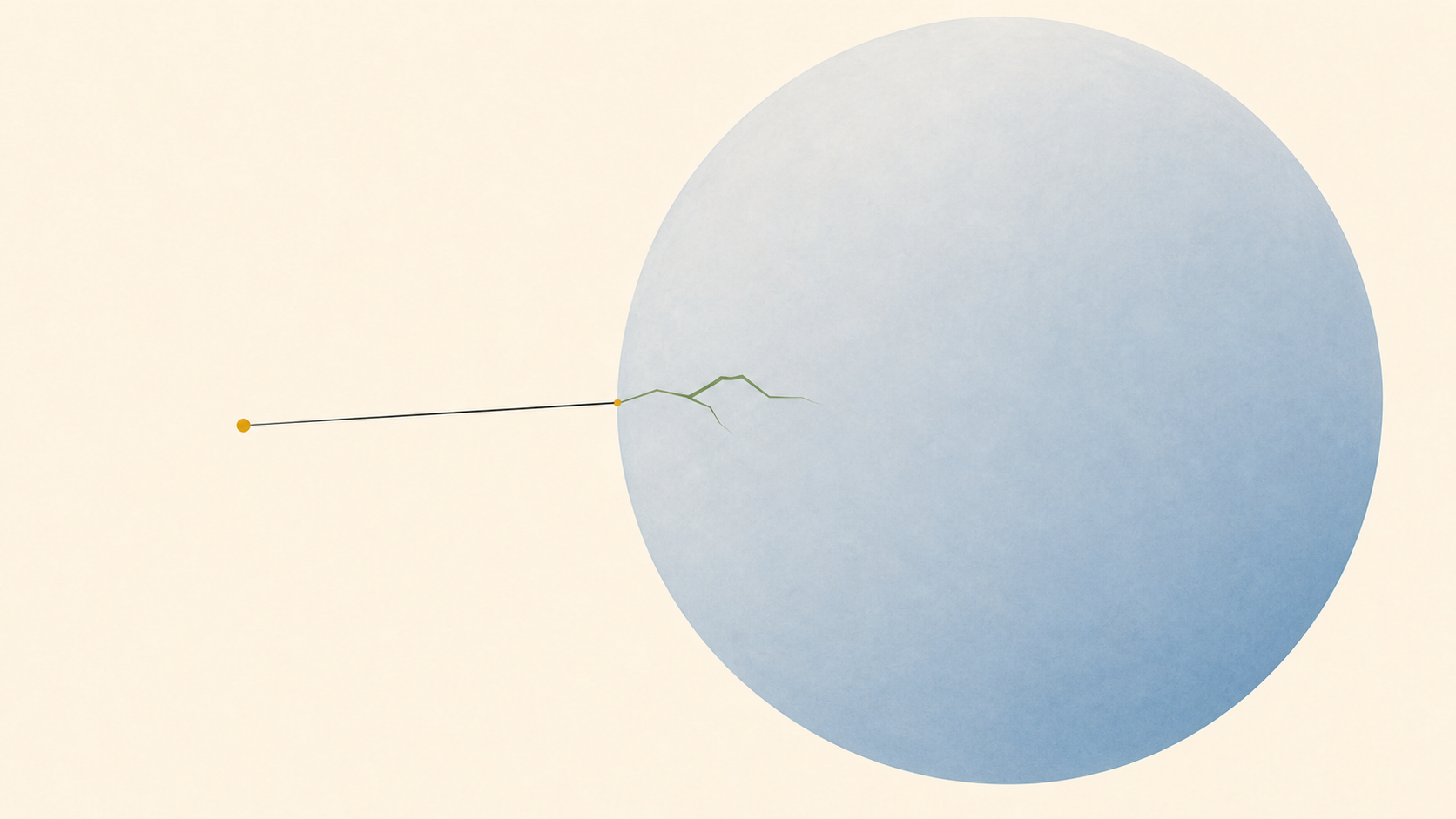
Reading The large blue circle is the broad hypothesis, and the tiny amber point is the critical experiment. A black needle aims at the causal hinge rather than surveying the whole space. The reading is that a small experiment can be powerful when it decides what we would believe or abandon; scale should sharpen the question, not hide a vague claim behind a large demo.

Ladder to the Open World

Research Thinking · Minimal Abstract

Original slogan

The open world matters, but strongly verified domains are often the right start.

Reading The small square is a strongly verified starting domain, while the pale sphere is the open world that research ultimately wants to reach. A stair connects them, implying controlled relaxation rather than a sudden leap. The interpretation is that open-world work needs a verification ladder: first prove a mechanism where feedback is reliable, then add ambiguity, scale, and realism step by step.

Fluency Gap

Research Thinking · Minimal Abstract

Original slogan

Do not mistake fluent expression for understanding.

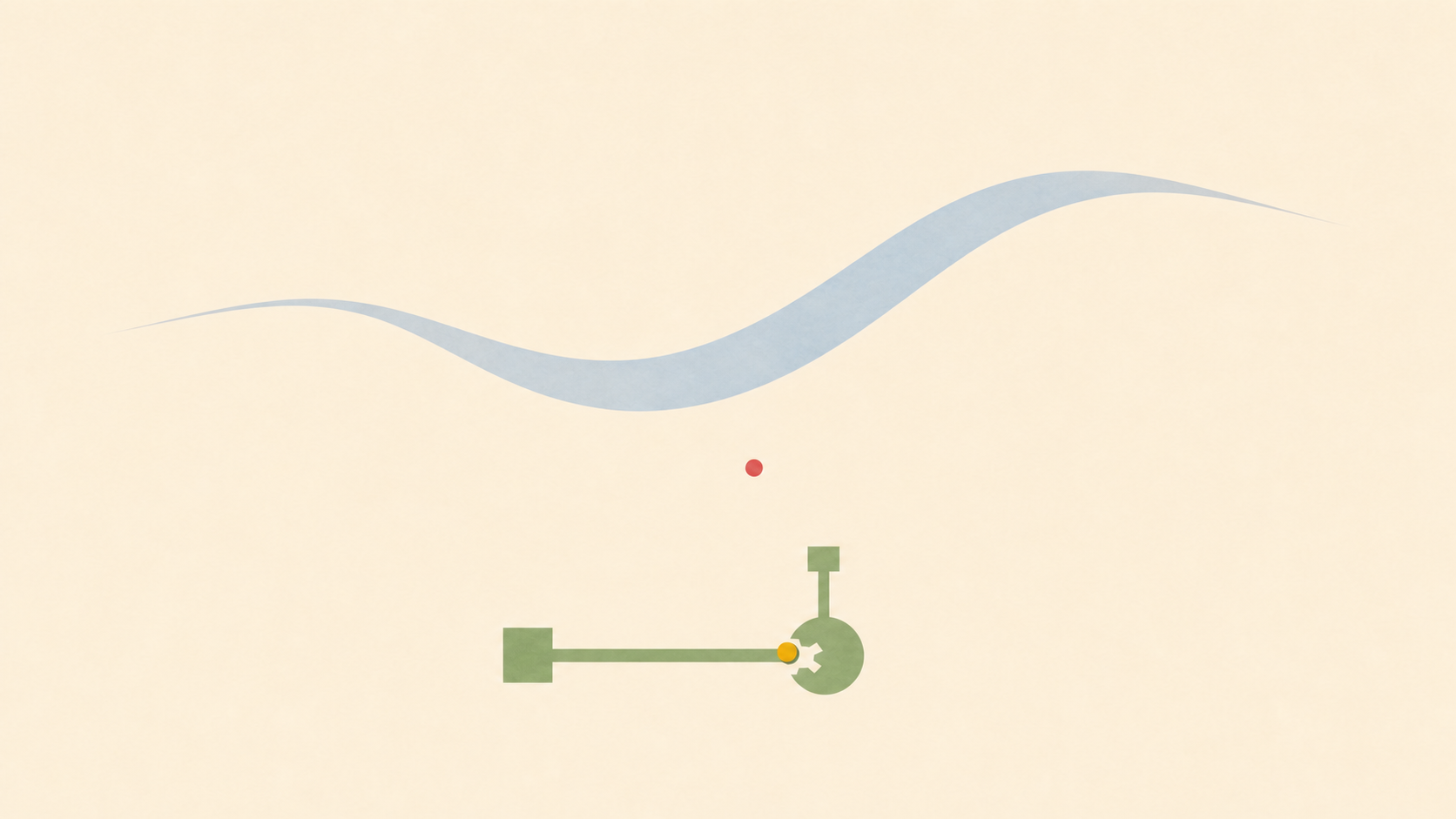
Reading The smooth blue ribbon is fluent expression: coherent, beautiful, and easy to over-trust. Beneath it sits the green executable mechanism, separated by a red gap that marks missing evidence. The reading is that language can be part of intelligence, but it should not be mistaken for understanding unless it connects to prediction, action, skill, recovery, or new knowledge.

Selective Memory

Research Thinking · Minimal Abstract

Original slogan

More memory is not always better.

Reading The archive is large but intentionally quiet, because volume alone is not intelligence. Only one memory tile crosses the retrieval boundary and connects to action; red stale fragments remain unused. The reading is that memory should reduce future cost and improve decisions, while bad memory creates retrieval burden, conflict, staleness, and misleading reuse.

Dual Boundary

Research Thinking · Minimal Abstract

Original slogan

System boundaries and learning boundaries matter equally.

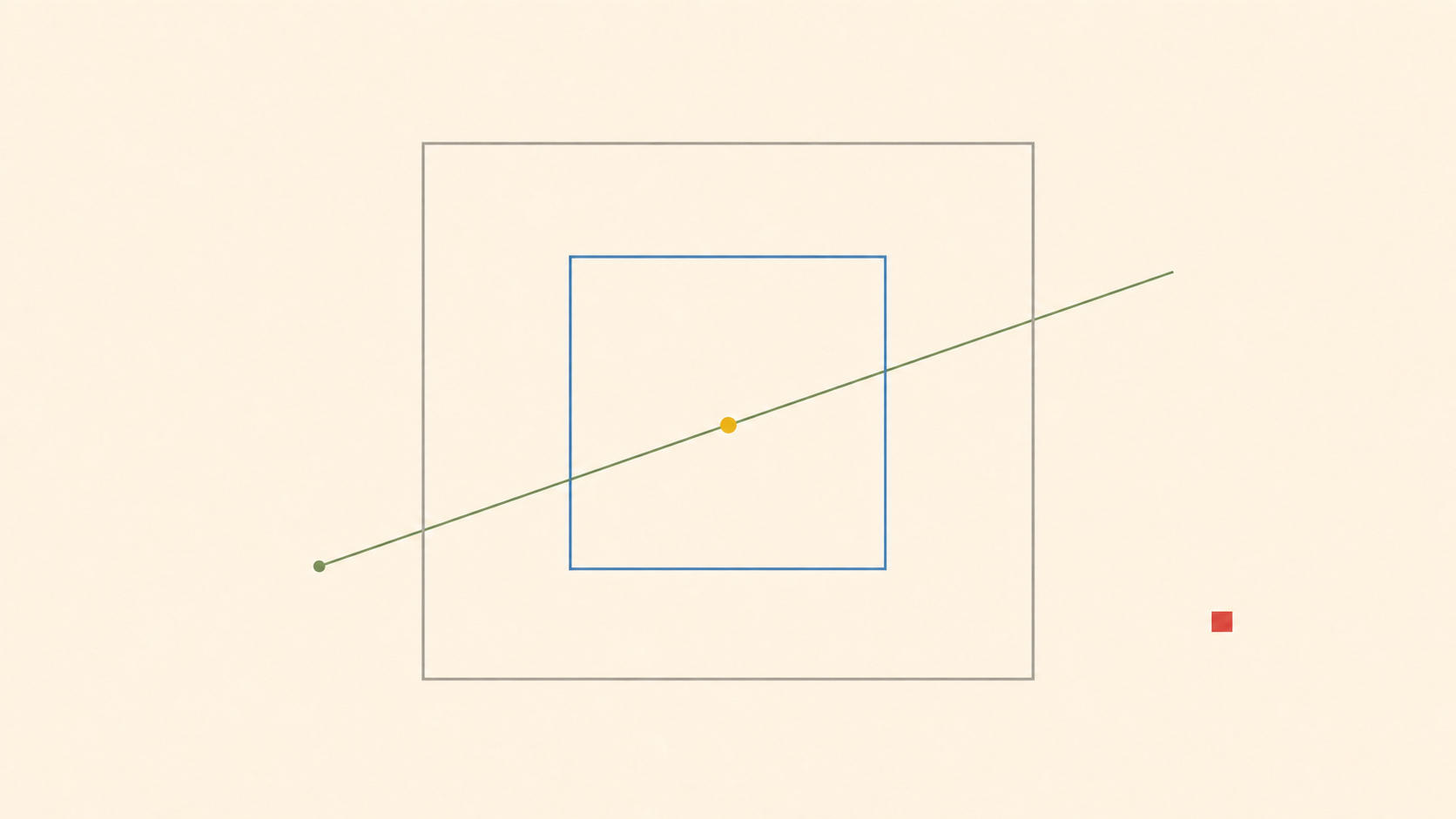
Reading The outer rectangle is the system boundary: model, tools, retrieval, users, protocols, and infrastructure. The inner rectangle marks the narrower place where learning actually happens. The reading is a warning against attributing all system behavior to the model; serious research must ask which part updates, which part stores, which part routes, and which part is only scaffolding.

Alignment Inside Learning

Research Thinking · Minimal Abstract

Original slogan

Alignment is not post-processing; it is part of learning.

Reading The green learning line and violet alignment line are braided from the beginning, not connected at the end. A late red patch floats apart to show the weakness of treating alignment as surface correction. The interpretation is that safety, trust, and controllability are learning-design questions: they shape feedback, objective, action space, environment, and update rule.

Generating New Evidence

Research Thinking · Minimal Abstract

Original slogan

Scientific discovery must generate new experience, not only compress old knowledge.

Reading The gray archive contains old knowledge, but the central green action creates something new: a blue evidence point that becomes valid only after amber feedback. The image separates literature compression from scientific discovery. The reading is that AI for Science should gradually move from summarizing papers to proposing experiments, generating observations, assigning failure causes, and producing reproducible evidence.

Diversity and Refutation

Research Thinking · Minimal Abstract

Original slogan

The value of multi-agent systems is not only division of labor, but diversity and refutation.

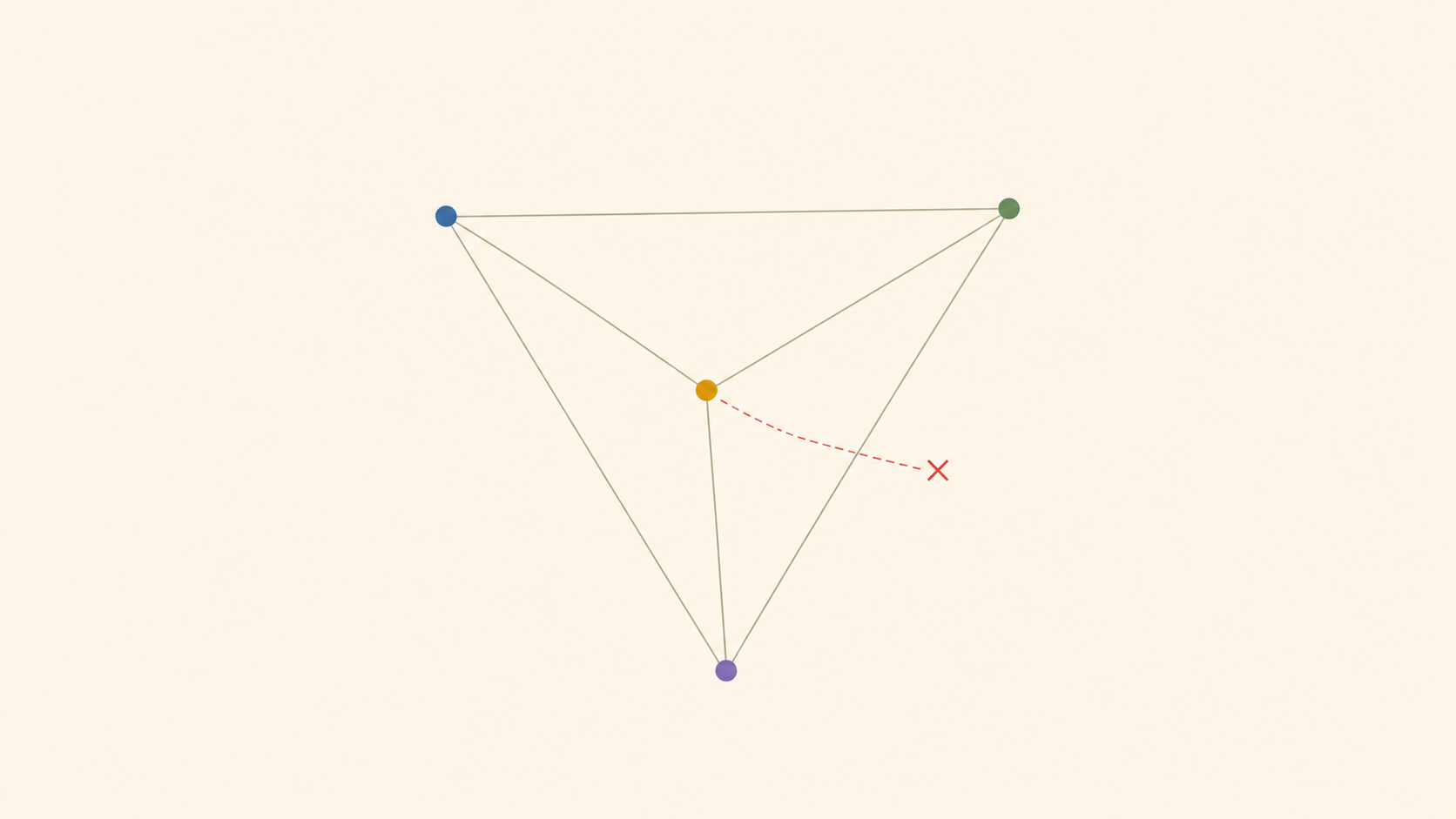
Reading Three agents form a triangle around a shared verification point, creating a small social geometry of claims and checks. The red contradiction is not erased; it bends the structure, showing that disagreement can become information. The reading is that multi-agent systems matter when they produce hypothesis diversity, adversarial checking, mutual correction, and richer feedback, not merely when a workflow is split into roles.

Research Taste

Research Thinking · Minimal Abstract

Original slogan

Research taste is rarer than the tech stack.

Reading Gray tool blocks fill the lower field, numerous and interchangeable. Above them, a small relation among blue structure, green action, and amber verification becomes the rare judgment point. The interpretation is that tools change quickly, but research taste is the slower ability to choose real problems, reject noisy progress, design falsifying tests, and notice which mechanisms can compound.

Cumulative Stair

Research Thinking · Minimal Abstract

Original slogan

Build cumulative science, not one-off demos.

Reading Blue-green verified blocks form a stair that can be climbed by later work. The red demo floats aside: striking, perhaps memorable, but disconnected from the staircase. The reading is that research accumulates only when it leaves reusable definitions, baselines, failures, tools, concepts, and hypotheses that future work can extend or overturn.

Earlier studies

Concept Studies in Abstract AI

Earlier visual notes on learning from experience, Rich Sutton's bitter lesson, temporal abstraction, and approximation.

AI Learning from Experience

After Kazimir Malevich · Suprematism

Reading The dominant black geometric body is the AI model itself — a deep "black box." Surrounding it, vivid fragments of red, yellow, and blue represent raw data and scattered experience, colliding and being absorbed into the centre. The sharp diagonal — a red beam — embodies gradient descent, cutting through chaos toward order. In Suprematism, the black square is the supreme origin; here it becomes the birthplace of cognition.

AI Learning from Experience

After Piet Mondrian · Neoplasticism

Reading The rigid black grid is the algorithmic framework — the architecture, activation functions, and loss constraints within which all learning must occur. Scattered small colour blocks on the left are isolated data points; the dense, interlocking cluster on the right is integrated knowledge. The visual narrative flows from sparse to dense: raw experience processed into structure. Mondrian strips reality down to primary elements; the AI does the same through feature extraction and dimensionality reduction.

AI Learning from Experience

After Wassily Kandinsky · Abstract Expressionism

Reading A spiritual journey from chaos to illumination. The lower-left is dark, muddy, teeming with undifferentiated blobs — raw, noisy data. Vision flows upward to a radiant, sun-like structure of concentric circles and geometric rays: the trained model, capable of prediction and understanding. The river of transformation between them — shapes brightening, lines connecting circles — is the training process itself. Sharp black lines cut through soft organic forms: algorithmic rigour taming the organic complexity of experience.

The Bitter Lesson — Generalization Hypothesis

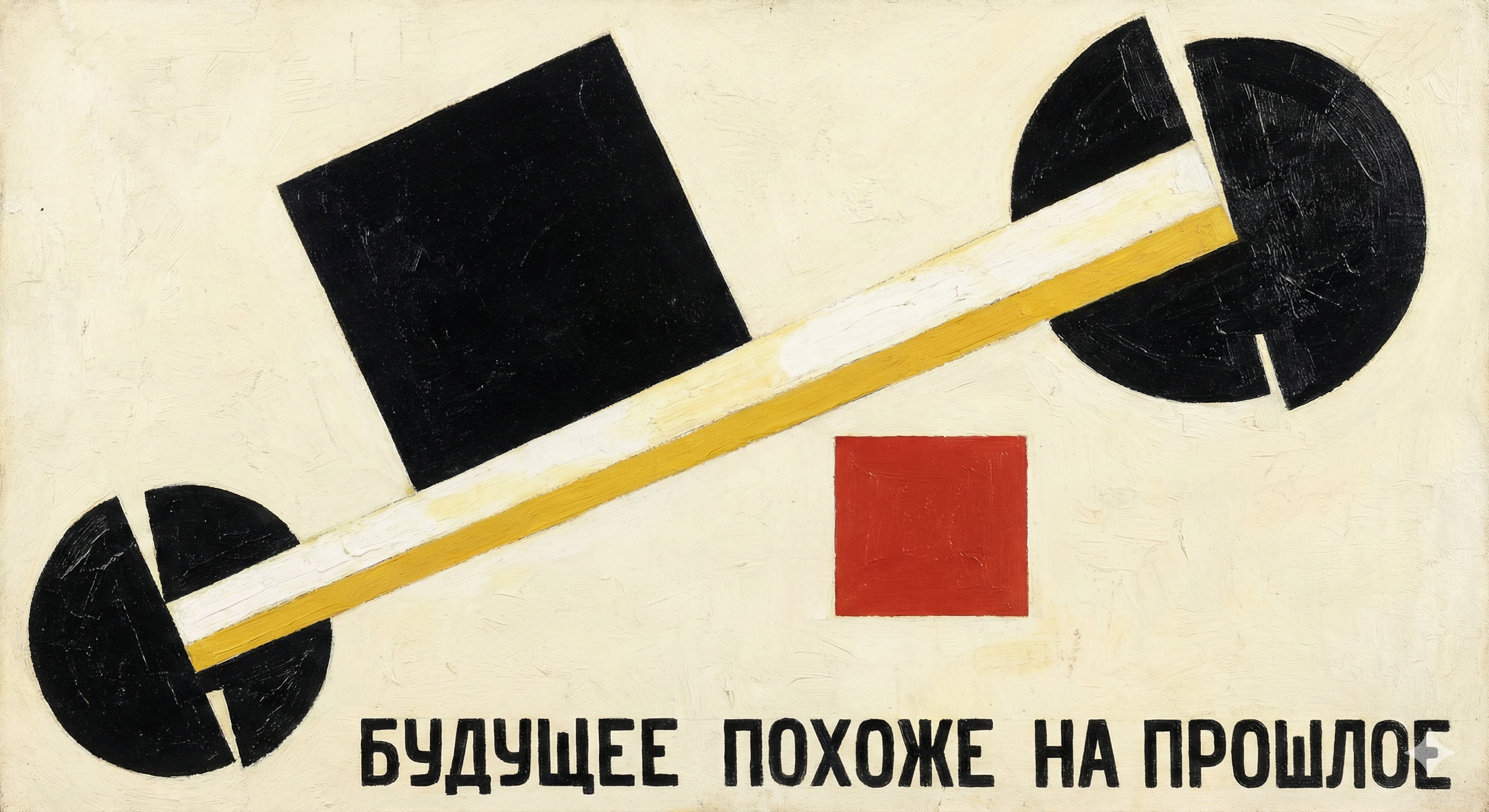
After Kazimir Malevich · Suprematism

Reading Visualising Rich Sutton's generalization hypothesis: "The future will resemble the past." The large black square (lower-left) is the Past — accumulated experience, the knowledge bedrock. The small black square (upper-right) is the Future — identical in nature but distant, not yet fully unfolded. The red diagonal beam connecting them is the hypothesis itself: because past and future are structurally alike, learned experience can transfer forward. The yellow circle floating between them is the Agent — the observer in the present, acting on the bridge of generalization.

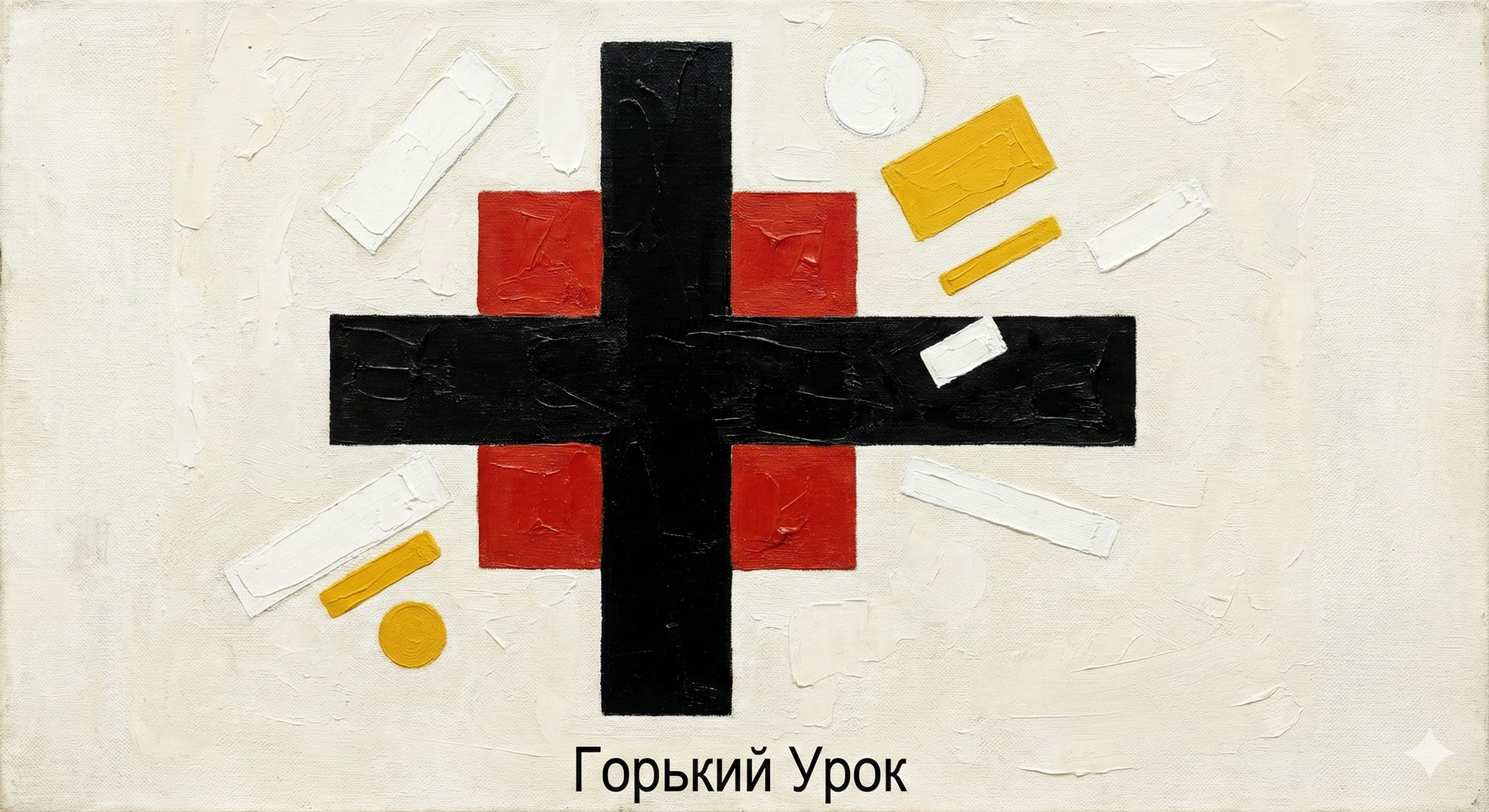
Горький Урок — The Bitter Lesson

After Kazimir Malevich · Suprematism

Reading The overwhelming black cross is Computation — the brute force that always wins. Scattered yellow and white fragments drifting around it are human heuristics: the clever hand-crafted tricks researchers build into AI systems. They look frail and insignificant against the crushing geometry of scale. The composition is stable, almost oppressive — conveying historical inevitability. Sutton's lesson is bitter because it wounds our pride: human ingenuity is not the blueprint for building intelligence. Scale is.

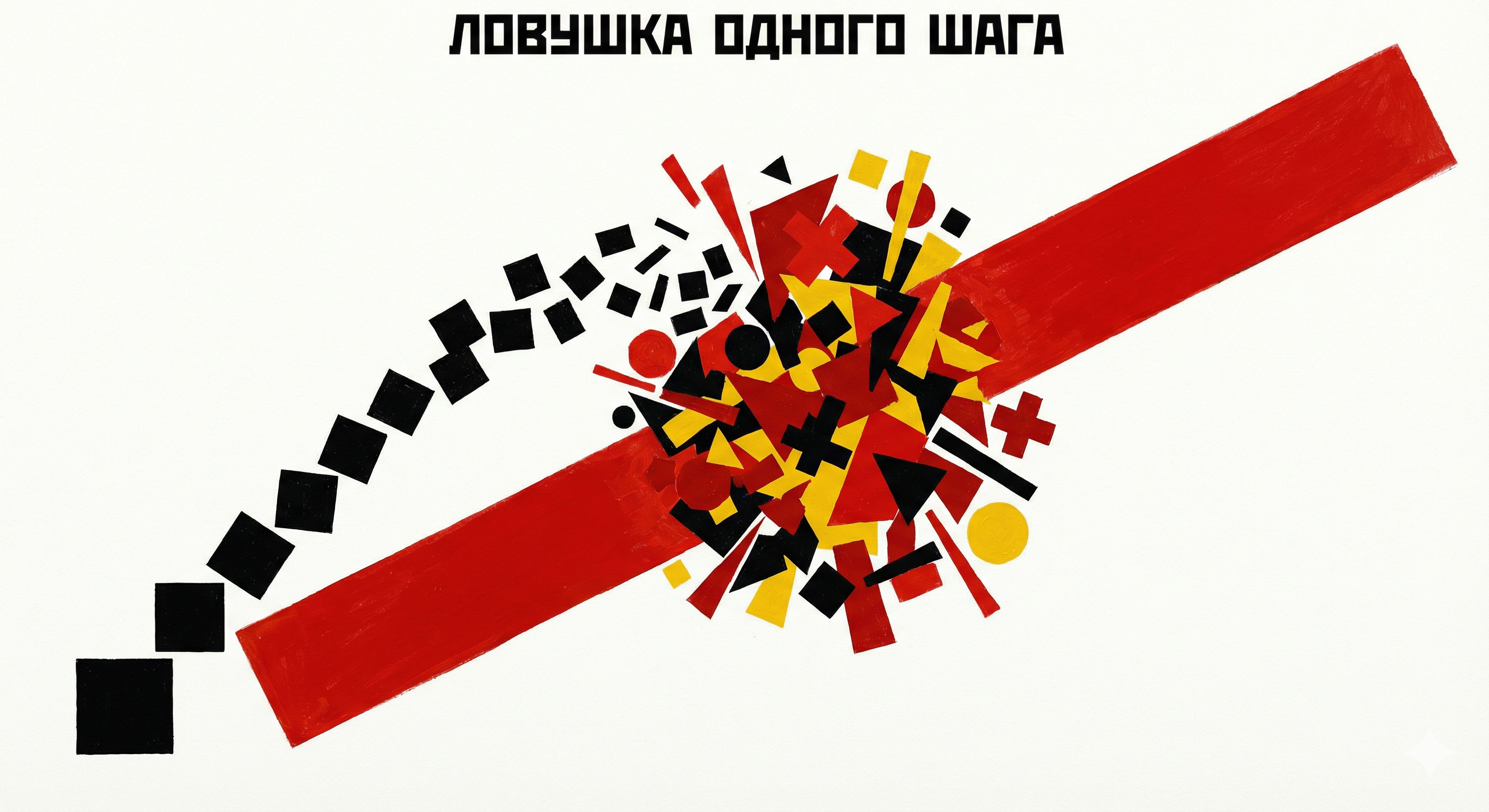
The One-Step Trap

After Kazimir Malevich · Suprematism

Reading A perfect small black square — the idealised "one-step prediction" — launches a trajectory of similar shapes toward the upper right. But the line immediately collapses: squares tilt, scatter, and drift into a dense, explosive cloud of red, black, and yellow debris — the exponential blow-up of compound error and branching possibilities. Cutting boldly across the entire canvas, a pure red rectangle leaps from the origin directly to the far side, bypassing the chaos entirely. This is temporal abstraction — the ability to skip steps, to think in terms of options and subgoals rather than moment-by-moment predictions.

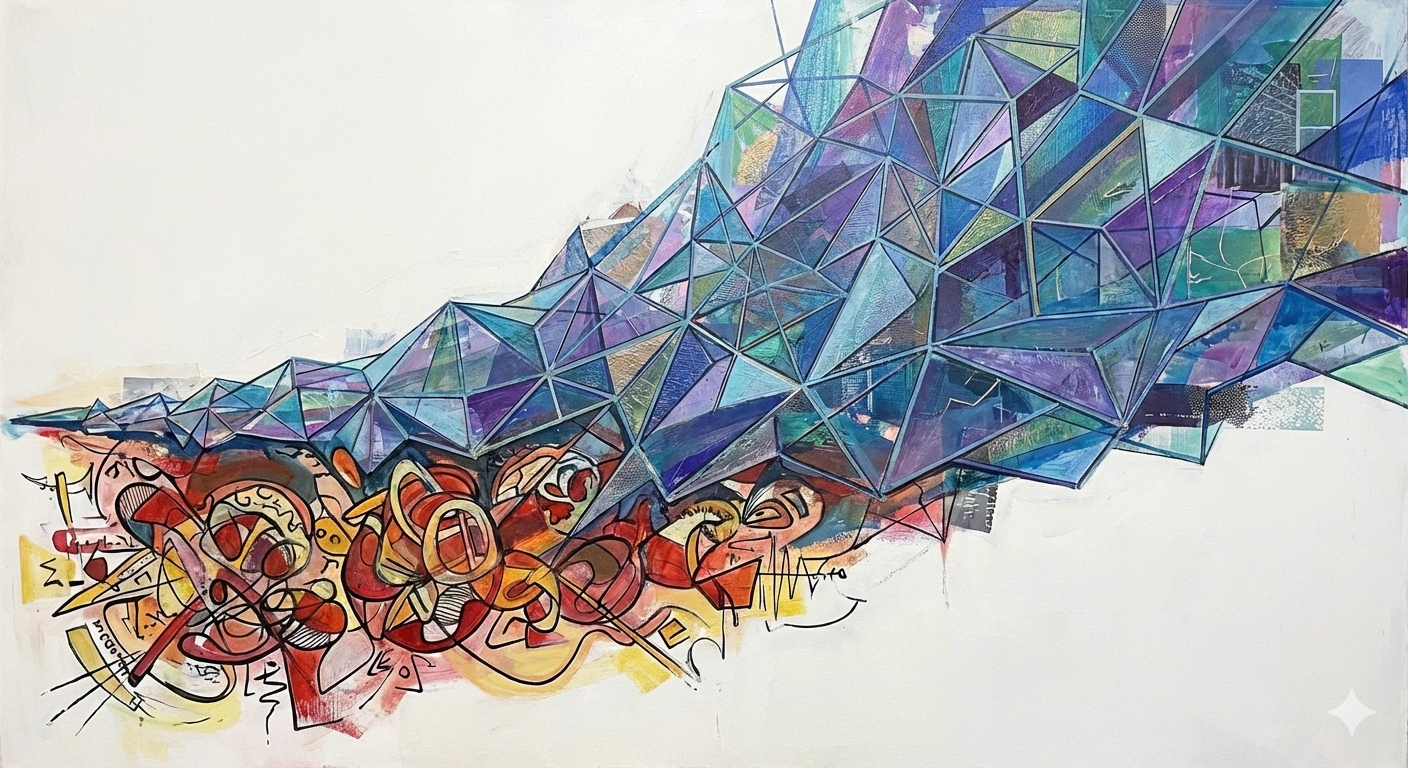
Embracing Approximation

Abstract · Digital

Reading The beauty of imperfect solutions. Approximation is not failure — it is the only path to intelligence at scale. Exact methods shatter against the curse of dimensionality; approximate methods bend and flow.

The Bitter Lesson

Abstract · Digital

Reading Rich Sutton's thesis in pure abstraction: general methods that leverage computation are ultimately the most effective. The lesson is bitter because it tells us that our cleverness matters less than we thought.

Created with GPT Image 2, Nano Banano × Gemini, and other AI image systems · Abstract art as research notes

Problem Before Method

Problem Before Method

Research Thinking · Minimal Abstract

Original slogan

Start from the problem, not the method.

Reading The dark gray mass is the real bottleneck: the part of the world that resists easy progress. Blue method fragments hover above it, useful but not yet grounded; the green line begins at the problem itself and only then reaches an amber verifier. The reading is that good research does not start by asking which fashionable method to use, but by locating the constraint that would matter if solved.
World Before Model

World Before Model

Research Thinking · Minimal Abstract

Original slogan

Start from the world, not the model.

Reading The wide gray-green plane is the world: environment, signal, action surface, and consequence. The small blue form is a model, but it is intentionally small because it mediates a loop rather than replacing the world. The image pushes against model-centric thinking and asks whether the system has a meaningful relation to feedback, intervention, and external structure.

Agent-Centered Cone

Agent-Centered Cone

Research Thinking · Minimal Abstract

Original slogan

Take the agent's point of view.

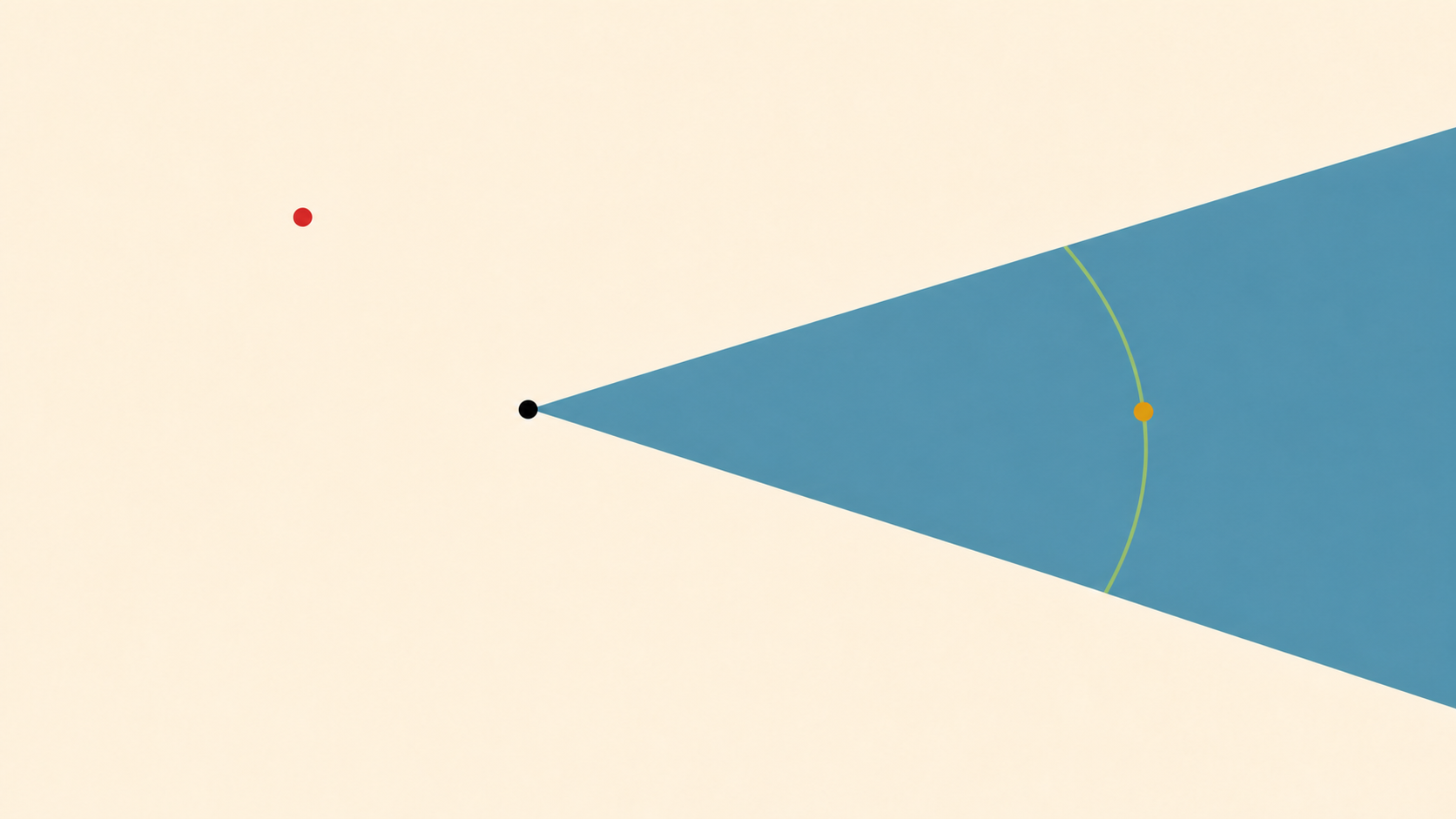
Reading The black aperture is the situated agent, and the blue cone is the portion of the world that becomes actionable from its position. It is not the observer's complete map; it is perception under limited information, cost, and delayed feedback. The red point outside the cone marks facts that may be true but cannot yet guide action, which is why agent-centered research must ask what the system can know, do, update, and recover from.

Experience Loop

Experience Loop

Research Thinking · Minimal Abstract

Original slogan

Experience is closer than static data to the source of intelligence.

Reading The pale stack is static data: valuable, broad, and historically accumulated, but inert by itself. The small loop of observation, action, feedback, and trace is made visually primary because it can create new information and alter the learner. The point is not anti-data; it is that intelligence begins to compound when data becomes experience and experience becomes update.

Verification Gate

Verification Gate

Research Thinking · Minimal Abstract

Original slogan

Do not let a system learn what it cannot verify.

Reading Gray fragments approach a violet verification gate; only one becomes a stable blue object after passing through. The red fragment remains outside as residue rather than being absorbed into memory. The reading is a discipline of learning hygiene: feedback can be weak, delayed, social, experimental, or formal, but its strength must be named before the system treats it as knowledge.

Capability, Not Score

Capability, Not Score

Research Thinking · Minimal Abstract

Original slogan

Measure capability; do not worship scores.

Reading The pale scoreboard is deliberately quiet: it records a number but does not prove capability. The green curve is anchored by amber measurements across contexts, suggesting transfer, persistence, recovery, and cost reduction. The interpretation is that benchmarks are instruments; they become misleading when the score replaces the ability concept it was supposed to measure.

Abstraction From Samples

Abstraction From Samples

Research Thinking · Minimal Abstract

Original slogan

Study abstraction, not only samples.

Reading A cloud of gray samples stays at the bottom while a blue structure rises out of it. The green action line and amber point make the abstraction testable rather than merely decorative. The reading is that intelligence is not the number of remembered cases, but the reusable structure extracted from experience and checked in new situations.

Useful World Structure

Useful World Structure

Research Thinking · Minimal Abstract

Original slogan

A world model does not replicate the world; it preserves useful structure.

Reading A faint background suggests the impossible fantasy of a full world replica. In the foreground, only the useful structure remains: a prediction arc, an action path, and a validation point. The interpretation is that a world model is valuable when it helps an agent plan, act, discover variables, and correct mistakes, not merely when it looks realistic.

Scalable Mechanism

Scalable Mechanism

Research Thinking · Minimal Abstract

Original slogan

Long-term routes should scale general mechanisms, not manual tricks.

Reading The upper form repeats and expands like a mechanism that can compound with more compute, data, environment, or experience. Below it, red trick fragments remain isolated: clever, perhaps useful once, but not a route. The reading separates scalable mechanisms such as search, learning, planning, memory, and verification from brittle manual patches that only survive inside one benchmark or product shape.

Failure Rewrites the Route

Failure Rewrites the Route

Research Thinking · Minimal Abstract

Original slogan

Good research can change its own failure conditions.

Reading A black hypothesis line hits a red failure boundary and then bends into a green route after the amber test point. The failure is not treated as an afterthought; it changes the path. The interpretation is that a research direction becomes scientific only when evidence can weaken it, redirect it, or force a clearer problem definition.

Small Experiment, Large Hypothesis

Small Experiment, Large Hypothesis

Research Thinking · Minimal Abstract

Original slogan

Use the smallest experiment to attack the largest hypothesis.

Reading The large blue circle is the broad hypothesis, and the tiny amber point is the critical experiment. A black needle aims at the causal hinge rather than surveying the whole space. The reading is that a small experiment can be powerful when it decides what we would believe or abandon; scale should sharpen the question, not hide a vague claim behind a large demo.

Ladder to the Open World

Ladder to the Open World

Research Thinking · Minimal Abstract

Original slogan

The open world matters, but strongly verified domains are often the right start.

Reading The small square is a strongly verified starting domain, while the pale sphere is the open world that research ultimately wants to reach. A stair connects them, implying controlled relaxation rather than a sudden leap. The interpretation is that open-world work needs a verification ladder: first prove a mechanism where feedback is reliable, then add ambiguity, scale, and realism step by step.

Fluency Gap

Fluency Gap

Research Thinking · Minimal Abstract

Original slogan

Do not mistake fluent expression for understanding.

Reading The smooth blue ribbon is fluent expression: coherent, beautiful, and easy to over-trust. Beneath it sits the green executable mechanism, separated by a red gap that marks missing evidence. The reading is that language can be part of intelligence, but it should not be mistaken for understanding unless it connects to prediction, action, skill, recovery, or new knowledge.

Selective Memory

Selective Memory

Research Thinking · Minimal Abstract

Original slogan

More memory is not always better.

Reading The archive is large but intentionally quiet, because volume alone is not intelligence. Only one memory tile crosses the retrieval boundary and connects to action; red stale fragments remain unused. The reading is that memory should reduce future cost and improve decisions, while bad memory creates retrieval burden, conflict, staleness, and misleading reuse.

Dual Boundary

Dual Boundary

Research Thinking · Minimal Abstract

Original slogan

System boundaries and learning boundaries matter equally.

Reading The outer rectangle is the system boundary: model, tools, retrieval, users, protocols, and infrastructure. The inner rectangle marks the narrower place where learning actually happens. The reading is a warning against attributing all system behavior to the model; serious research must ask which part updates, which part stores, which part routes, and which part is only scaffolding.

Alignment Inside Learning

Alignment Inside Learning

Research Thinking · Minimal Abstract

Original slogan

Alignment is not post-processing; it is part of learning.

Reading The green learning line and violet alignment line are braided from the beginning, not connected at the end. A late red patch floats apart to show the weakness of treating alignment as surface correction. The interpretation is that safety, trust, and controllability are learning-design questions: they shape feedback, objective, action space, environment, and update rule.

Generating New Evidence

Generating New Evidence

Research Thinking · Minimal Abstract

Original slogan

Scientific discovery must generate new experience, not only compress old knowledge.

Reading The gray archive contains old knowledge, but the central green action creates something new: a blue evidence point that becomes valid only after amber feedback. The image separates literature compression from scientific discovery. The reading is that AI for Science should gradually move from summarizing papers to proposing experiments, generating observations, assigning failure causes, and producing reproducible evidence.

Diversity and Refutation

Diversity and Refutation

Research Thinking · Minimal Abstract

Original slogan

The value of multi-agent systems is not only division of labor, but diversity and refutation.

Reading Three agents form a triangle around a shared verification point, creating a small social geometry of claims and checks. The red contradiction is not erased; it bends the structure, showing that disagreement can become information. The reading is that multi-agent systems matter when they produce hypothesis diversity, adversarial checking, mutual correction, and richer feedback, not merely when a workflow is split into roles.

Research Taste

Research Taste

Research Thinking · Minimal Abstract

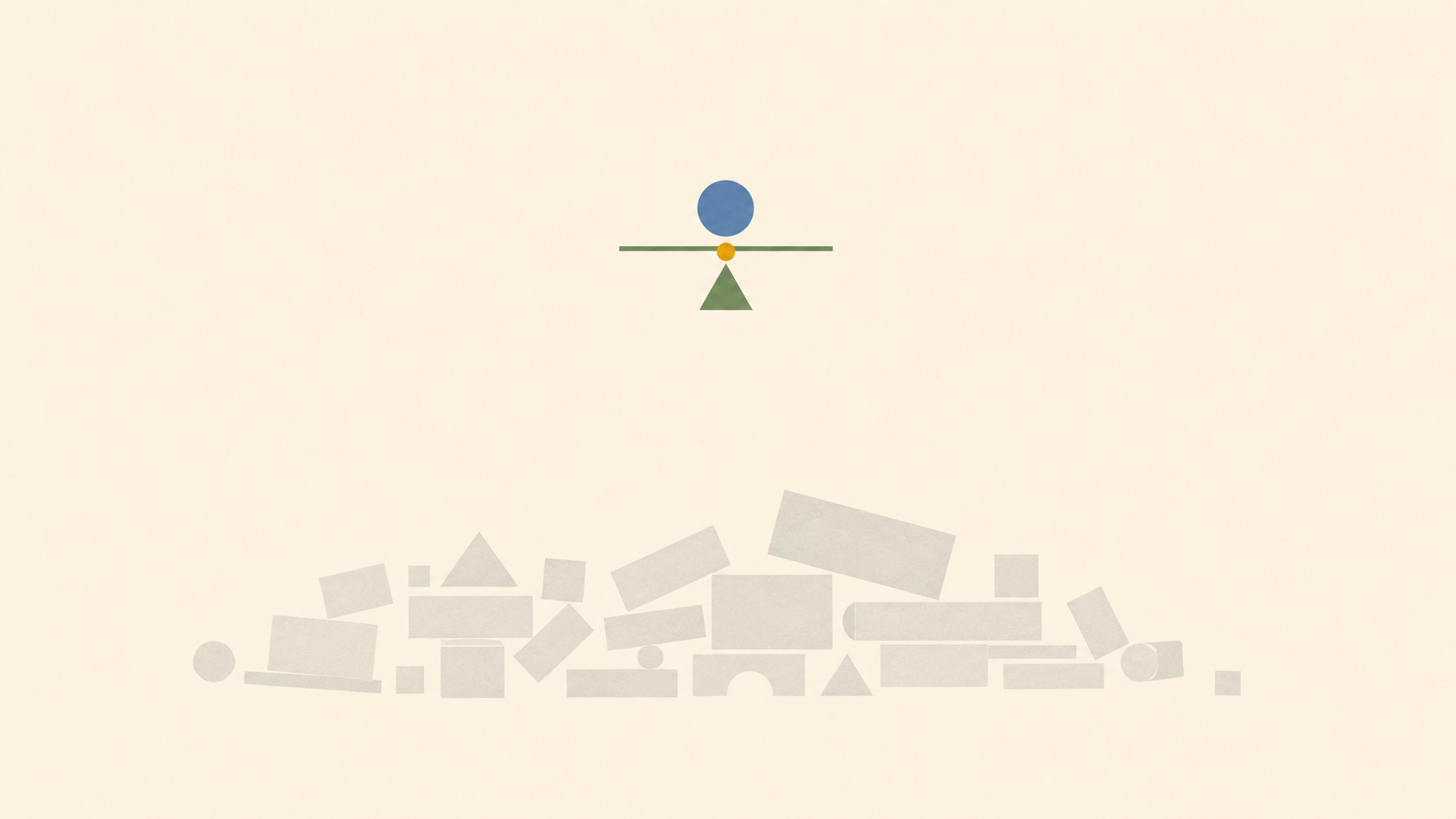
Original slogan

Research taste is rarer than the tech stack.

Reading Gray tool blocks fill the lower field, numerous and interchangeable. Above them, a small relation among blue structure, green action, and amber verification becomes the rare judgment point. The interpretation is that tools change quickly, but research taste is the slower ability to choose real problems, reject noisy progress, design falsifying tests, and notice which mechanisms can compound.

Cumulative Stair

Cumulative Stair

Research Thinking · Minimal Abstract

Original slogan

Build cumulative science, not one-off demos.

Reading Blue-green verified blocks form a stair that can be climbed by later work. The red demo floats aside: striking, perhaps memorable, but disconnected from the staircase. The reading is that research accumulates only when it leaves reusable definitions, baselines, failures, tools, concepts, and hypotheses that future work can extend or overturn.

AI Learning from Experience

AI Learning from Experience

After Kazimir Malevich · Suprematism

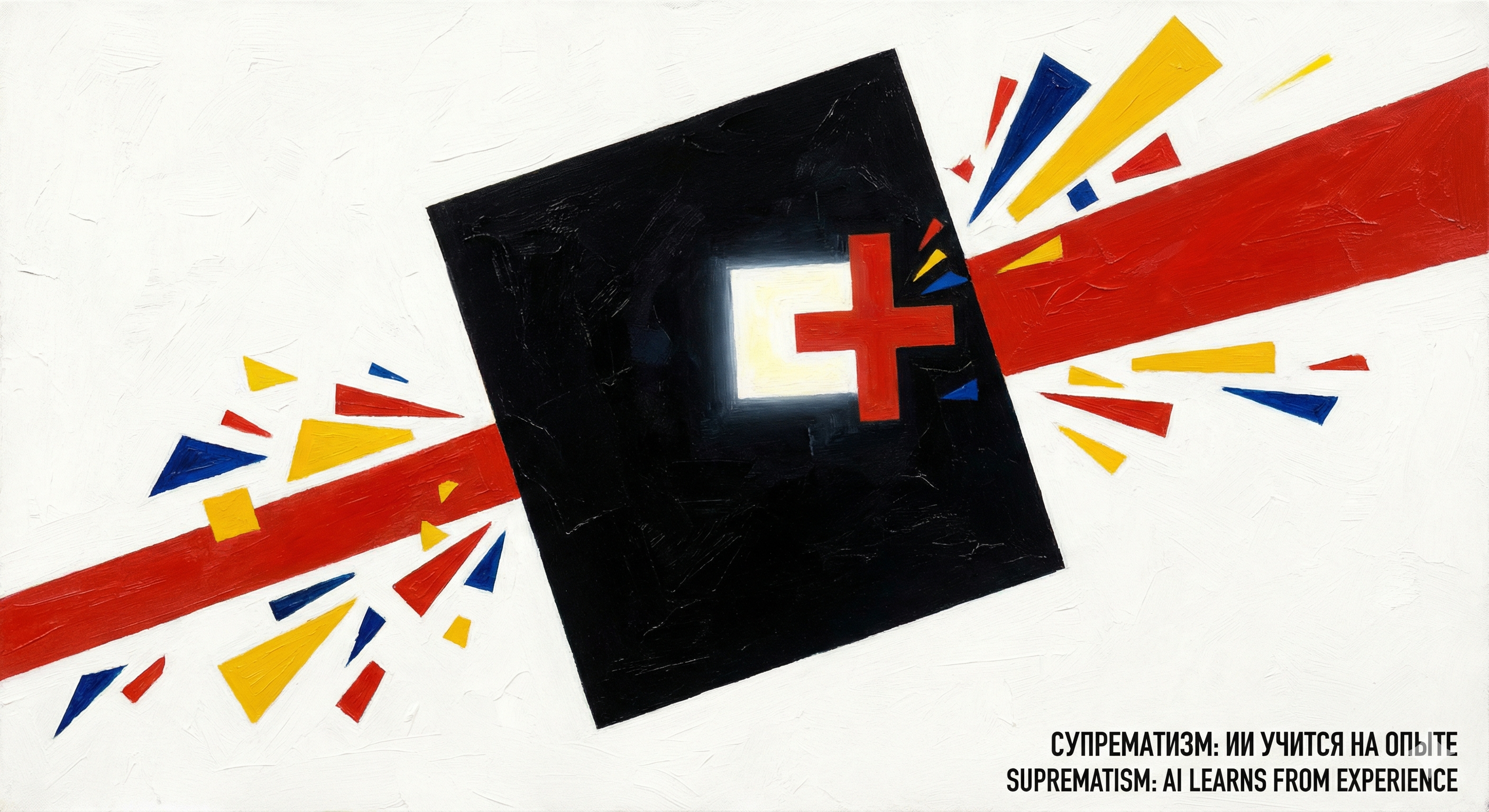
Reading The dominant black geometric body is the AI model itself — a deep "black box." Surrounding it, vivid fragments of red, yellow, and blue represent raw data and scattered experience, colliding and being absorbed into the centre. The sharp diagonal — a red beam — embodies gradient descent, cutting through chaos toward order. In Suprematism, the black square is the supreme origin; here it becomes the birthplace of cognition.

AI Learning from Experience

AI Learning from Experience

After Piet Mondrian · Neoplasticism

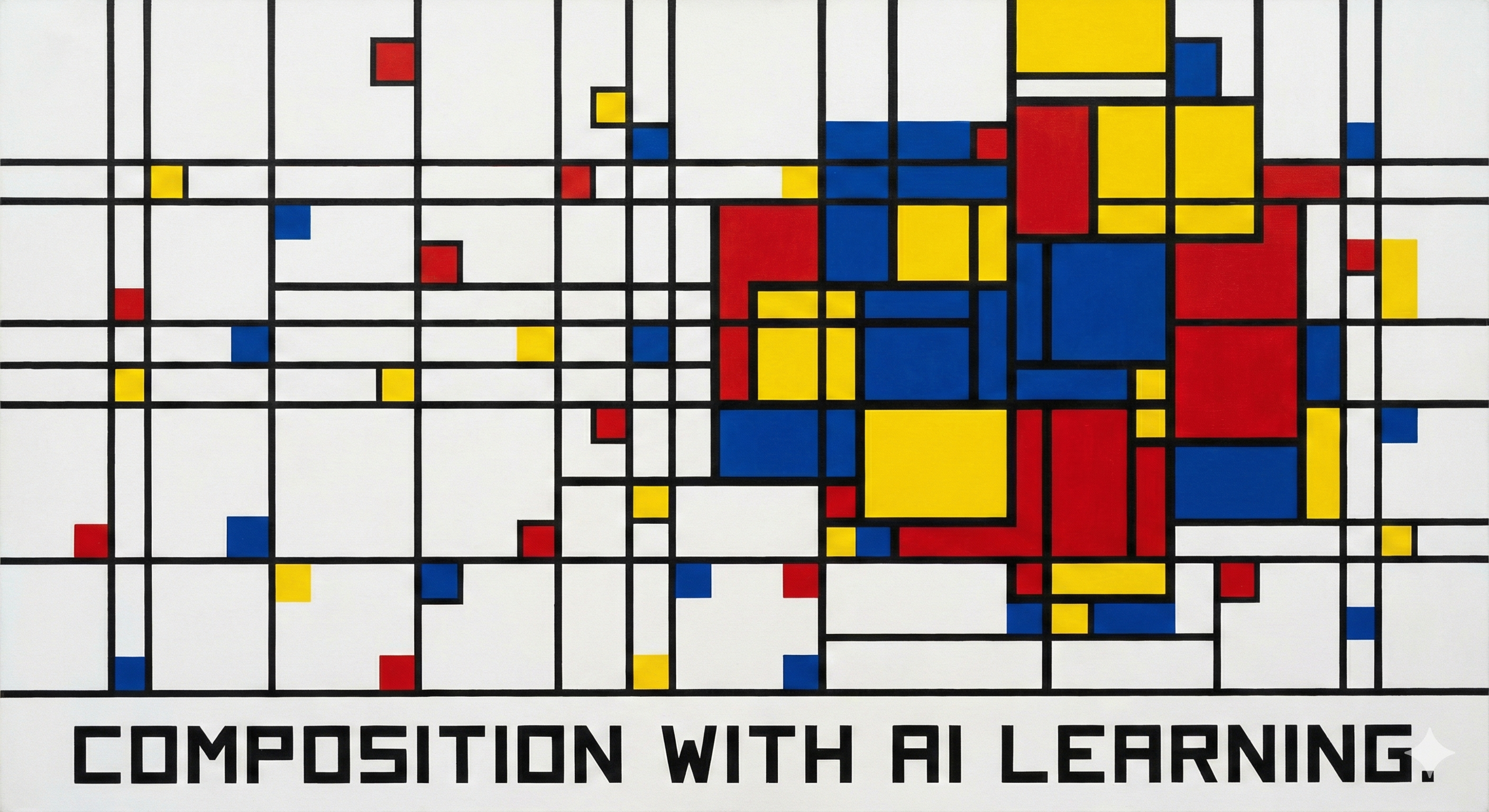
Reading The rigid black grid is the algorithmic framework — the architecture, activation functions, and loss constraints within which all learning must occur. Scattered small colour blocks on the left are isolated data points; the dense, interlocking cluster on the right is integrated knowledge. The visual narrative flows from sparse to dense: raw experience processed into structure. Mondrian strips reality down to primary elements; the AI does the same through feature extraction and dimensionality reduction.

AI Learning from Experience

AI Learning from Experience

After Wassily Kandinsky · Abstract Expressionism

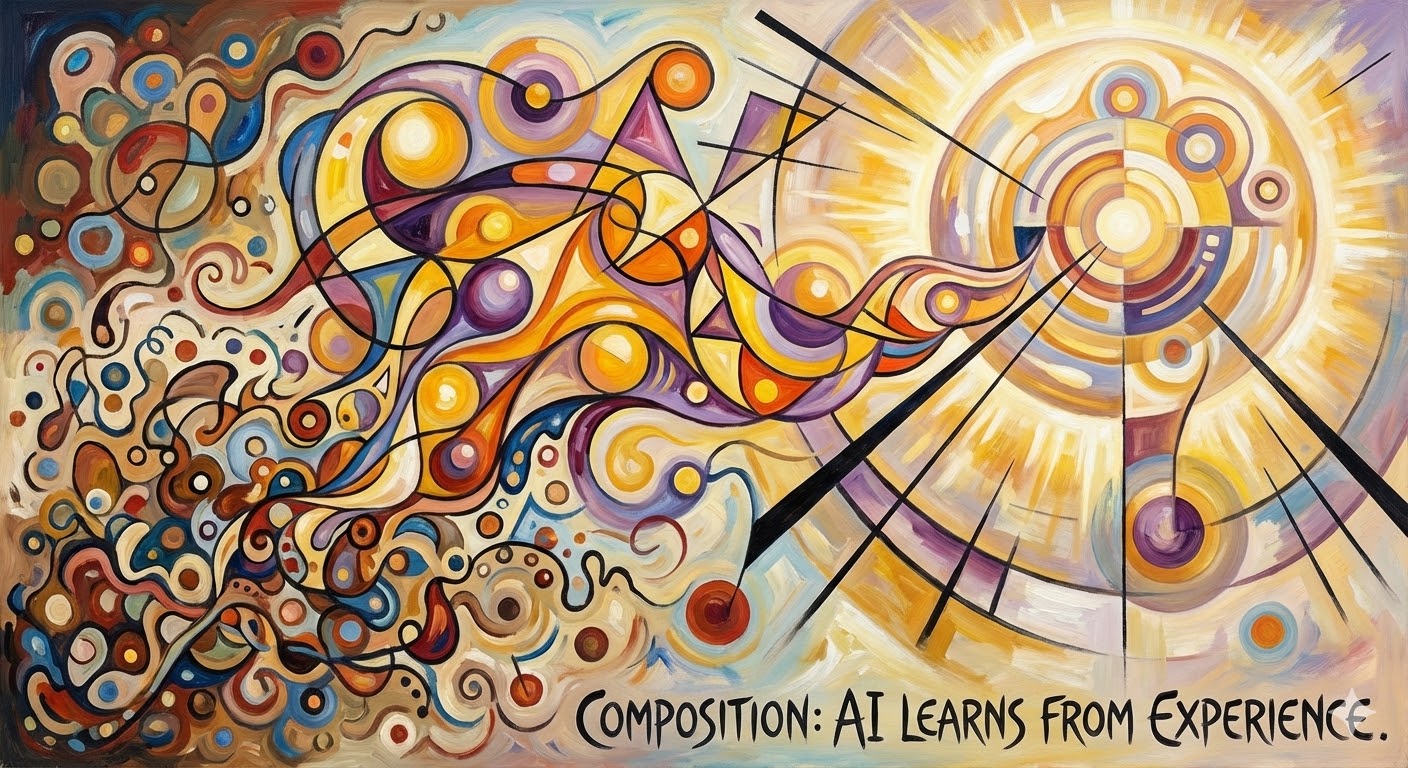
Reading A spiritual journey from chaos to illumination. The lower-left is dark, muddy, teeming with undifferentiated blobs — raw, noisy data. Vision flows upward to a radiant, sun-like structure of concentric circles and geometric rays: the trained model, capable of prediction and understanding. The river of transformation between them — shapes brightening, lines connecting circles — is the training process itself. Sharp black lines cut through soft organic forms: algorithmic rigour taming the organic complexity of experience.

The Bitter Lesson — Generalization Hypothesis

The Bitter Lesson — Generalization Hypothesis

After Kazimir Malevich · Suprematism

Reading Visualising Rich Sutton's generalization hypothesis: "The future will resemble the past." The large black square (lower-left) is the Past — accumulated experience, the knowledge bedrock. The small black square (upper-right) is the Future — identical in nature but distant, not yet fully unfolded. The red diagonal beam connecting them is the hypothesis itself: because past and future are structurally alike, learned experience can transfer forward. The yellow circle floating between them is the Agent — the observer in the present, acting on the bridge of generalization.

Горький Урок — The Bitter Lesson

Горький Урок — The Bitter Lesson

After Kazimir Malevich · Suprematism

Reading The overwhelming black cross is Computation — the brute force that always wins. Scattered yellow and white fragments drifting around it are human heuristics: the clever hand-crafted tricks researchers build into AI systems. They look frail and insignificant against the crushing geometry of scale. The composition is stable, almost oppressive — conveying historical inevitability. Sutton's lesson is bitter because it wounds our pride: human ingenuity is not the blueprint for building intelligence. Scale is.

The One-Step Trap

The One-Step Trap

After Kazimir Malevich · Suprematism

Reading A perfect small black square — the idealised "one-step prediction" — launches a trajectory of similar shapes toward the upper right. But the line immediately collapses: squares tilt, scatter, and drift into a dense, explosive cloud of red, black, and yellow debris — the exponential blow-up of compound error and branching possibilities. Cutting boldly across the entire canvas, a pure red rectangle leaps from the origin directly to the far side, bypassing the chaos entirely. This is temporal abstraction — the ability to skip steps, to think in terms of options and subgoals rather than moment-by-moment predictions.

Embracing Approximation

Embracing Approximation

Abstract · Digital

Reading The beauty of imperfect solutions. Approximation is not failure — it is the only path to intelligence at scale. Exact methods shatter against the curse of dimensionality; approximate methods bend and flow.

The Bitter Lesson

The Bitter Lesson

Abstract · Digital

Reading Rich Sutton's thesis in pure abstraction: general methods that leverage computation are ultimately the most effective. The lesson is bitter because it tells us that our cleverness matters less than we thought.

© 2026 Ying Wen. Shanghai Jiao Tong University.

Scholar GitHub Email RSS